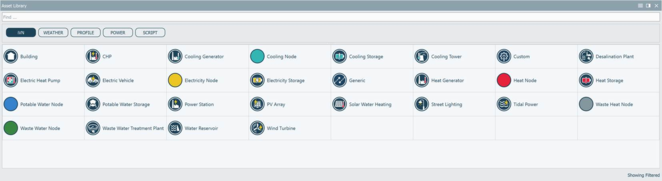
iVN Assets are buildings, devices, or other forms of technology that provide, consume, or store one or more commodities at a network node. They are added to the iVN model using drag and drop from the asset library (see Figure 4-1 and Section 3.11) to the 2D iVN (Level 1) and 2D infrastructure (level 2) workspace view.
Figure 4-1: 2D iVN assets
Providers are assets that meet the demand at a node either by capturing energy from weather sources or by burning a fuel. Providers are typically dispatchable (their output is determined by the demand as well as the environment) but some assets (typically PV arrays and wind turbines), can be non-dispatchable if energy feedback is permitted.
Consumers are assets that consume another network commodity (typically electricity) and therefore add demand to the network in addition to buildings. The consumption of electricity is either calculated based purely on asset settings (street lighting and EV charging stations) or based on both asset settings and the demand for another provided commodity (such as electric heat pumps, solar water heaters, cooling generators and cooling towers).
Storage devices are assets which automatically store any surplus commodities at a node and release it if providers cannot meet the demand at a node (they are non-dispatchable).
Some assets deal with multiple commodities and therefore impose a calculation order on the set of network nodes. The order is constrained by the various nodes and objects attached to the node according to the following constraints:
· A child node is calculated before a parent node, regardless of the type of node
· CHP: If power-matching mode is on, the electricity node is calculated before the heat node. If power-matching mode is off (heat-matching mode), the heat node is calculated before the electricity node
· Cooling generator: the cooling node is calculated before the electricity node and waste heat node
· Cooling tower: the waste heat node is calculated before the electricity node
· Electric heat pump: the heat node is calculated before the electricity node
· Solar water heating: the heat node is calculated before the electricity node
Because of these dependencies, care must be taken when attaching multiple assets to nodes to ensure that no cyclic dependencies arise (for example, by attaching a power-matching CHP and a heat-matching CHP to the same nodes).