A sequential strategy performs a sequence of allocations in a prescribed order. The three kinds of allocations available are:
· Installation allocation: an amount of provision is allocated to an installation
· External allocation: an amount of provision is allocated to the next node in the hierarchy (if the manager's node has a parent node) or to the external supply (if the manager's node is the root node)
· Strategy allocation: an amount of provision is allocated to another strategy
An allocation performed by an installation allocation in a sequential strategy is cancelled if the allocation is below the minimum provision of the installation. Any residual demand left-over after a manager has performed all of its scheduled allocations is assumed to be assigned to the external supply. Consequently, it is not necessary to define an explicit external allocation object unless it is required to allocate some energy before installations.
It is possible for a sequence to skip a step if an installation allocation would be put the provision below the minimum provision. The first allocation must be above the minimum provision for a successful allocation to occur. Also, if there is no remaining demand, subsequent steps are performed but nothing is allocated
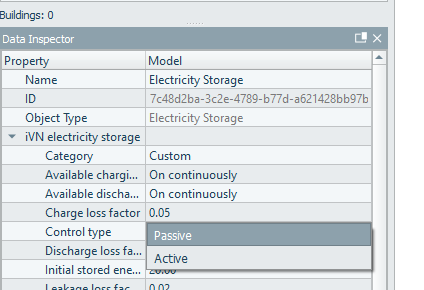
If an installation allocation references a storage installation, the storage installation must be have the Control Type = Active (Figure 3-40).
Figure3-40:Storage; passive or active control type
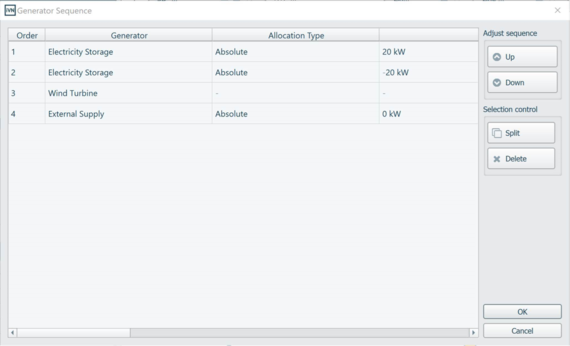
If this is the case, the value can be positive or negative (positive for discharging, negative for charging). If charging is requested, it will add to the demand value in the strategy. Therefore, generators that are generating more than their load in order to charge storage devices must come after the storage installations in the sequence (Figure 3-41).
Figure3-41:Active storage, discharge (+ve) and charge (-ve)