Different standards utilise different conventions for where dimensions are taken-off for thermal bridging Psi value derivation, for example:
ISO 14683: 2017 provides Psi values for internal, external and mid-point planes.
ASHRAE 90.1: 2019 is based on Psi values for the external plane.
ASHRAE RP 1365: 2011 is based on Psi values for the internal plane.
Building Envelope Thermal Bridging-Guide v1.5 2020 (BETB) is based on Psi values for the internal plane.
UK SAP 10.2 and UK Part L2 2021 is based on Psi values for the internal plane.
Passivhaus / AECB is based on Psi values for the external plane.
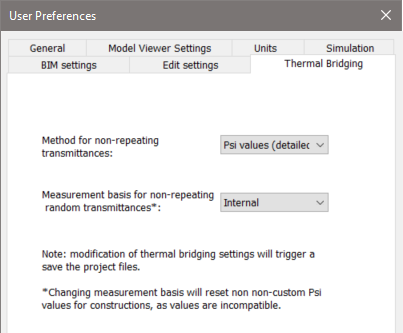
In the VE the dimensional convention to be used for taking-off linear non-repeating transmittances is set on the Tools menu > Preferences dialog > Bridging tab.
Fig: Dimensional convention setting
By default, the convention is set to internal.
When setting the dimensional convention users should be cognisant of how their model is drawn and the approximations involved, for example:
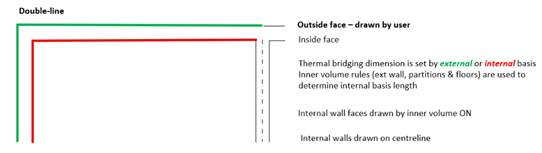
Double-line models are typically drawn to the outside face of external walls. Inner volumes are then generated such that surface areas and volumes are close to the actual building geometry. In this instance the take-off of linear non-repeating transmittance lengths will be accurate for both dimensional conventions / datasets.
Fig: Double-line linear non-repeating transmittance take-off
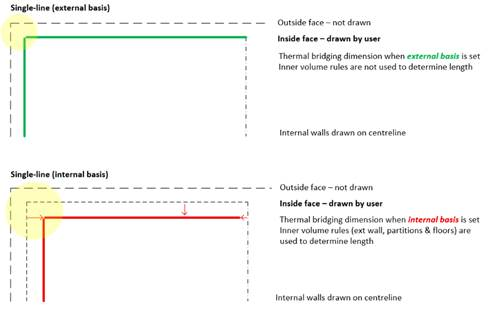
Single-line models are typically drawn to the inside face of external walls and represent a quicker user workflow, but surface areas and volumes are more approximate to those of the actual building geometry, because the external face is not drawn. In this instance the take-off of linear non-repeating transmittance lengths will be less accurate because of the dimensional impact of corners.
Fig: Single-line linear non-repeating transmittance take-off
The above Figure suggests the error involved is likely to be typically small in a whole building context for all but small buildings. The user could consider mitigating this issue in such instances by setting the dimensional convention to external and picking an internal based Psi dataset.
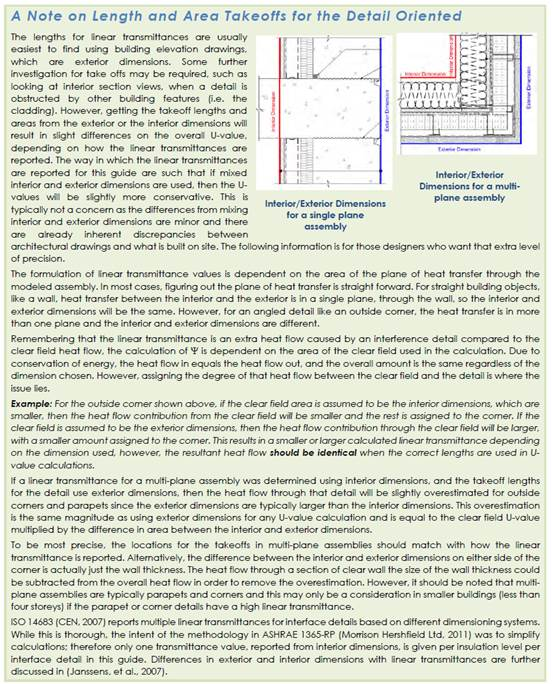
The Building Envelope Thermal Bridging-Guide v1.5 2020 (3.4.1, page 15 inset) extract shown in figure 2 discusses in detail the consequences of internal or external measurements, however it also points-out that differences in dimensions are inherent on drawings and when as-built so it is important to bear such tolerances in mind.
Fig: Impact of the dimensional convention (extract from BETB v1.5)
Warning: the convention should be set at the start of a project. If the convention is changed to external it will reset all defaults in ApCDB to ISO14683:2017 with the first reference detail & Psi value for each transition entry. All custom input values will be retained, however will require manual updating.