ASHRAE 90.1 2019 Section 11 ECB Supporting document (to be used in conjunction with the 90.1 2019 PRM navigator)
The intent of this document is to outline and provide guidance regarding workflow when using the VE ASHRAE 90.1 PRM navigator to complete analysis for 90.1-2019 section 11 Energy Cost Budget (ECB) method.
Because the PRM (Appendix G) and ECB (Chapter 11) ASHRAE rule sets are similar, using the PRM & ECB Navigator will streamline either of the PRM or ECB energy modeling exercises. In order to work effectively with this navigator to develop an ECB model, it is important to be aware of the differences between the two energy modeling rule sets. The following describes, in brief, what should be considered when implementing the ECB Method through the use of this navigator.
1. Selection of the ECB method for ASHRAE 90.1 Workflow Navigator
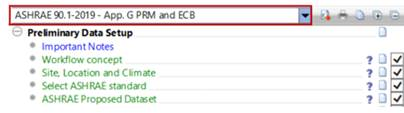
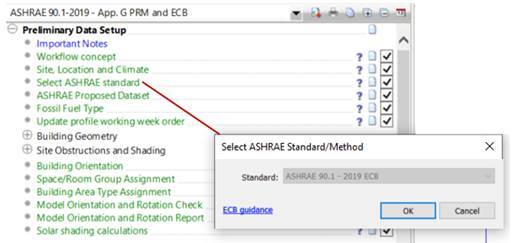
Action: Click the “Select ASHRAE standard” navigator action item and select the option for “ASHRAE 90.1-2019 ECB”. This will automatically generate the ECB Budget model within this Navigator workflow and auto-generate the ECB Budget model reports
2. A single baseline model for ECB analysis
For the ECB method, the baseline model is referred to as the Budget model and is generated and simulated only at the same orientation as the proposed. This is handled automatically by the navigator when in ECB mode for both loads calculations and simulations.
3. ECB HVAC systems
Autosized prototype systems have been developed with reference to table 11.5.2-1 to accommodate the ASHRAE 90.1-2019 ECB HVAC Systems. When the “Edit current Baseline” navigator workflow is selected the relevant ECB budget system should be selected from the “ECB systems” prototype library.
The systems have also been added into the HVAC Systems Wizard.
The following should be noted for ECB 2019 specifically:
· As the Budget model system fan power requirements differ from those of the PRM Baseline, the Budget system fan inputs must be manually edited after system auto sizing has been completed
o For details of the calculations required see section 11.5.2c
· ECB 2019 section 11.5.2d defines the Minimum Outdoor Air Ventilation Rate to be used in the budget building. This is manually adjusted by the user.
o New exceptions have been added as follows:
§ When modeling demand control ventilation in the proposed design for spaces where demand control ventilation is not required per Section 6.4.3.8
§ Where the minimum outdoor air intake flow in the proposed design is provided in excess of the amount required by Section 6.5.3.7, the baseline building design shall be modeled to reflect the minimum amount required by Section 6.5.3.7
· ECB 2019 have updates to the supply airflow rates in the budget building. This is manually adjusted by the user in the budget systems when required.
o Further details can be found in section 11.5.2g
4. Thermal Mass for ECB Budget Model Opaque Construction Assembly
Budget model Opaque assemblies including roofs, floors, walls, and doors are modeled using performance parameters (assembly U-value, insulation R-value, etc.) in ASHRAE 90.1 Tables 5.5 (same as PRM); however the budget assemblies are automatically modeled with the same heat capacity or thermal mass as the proposed building assemblies.
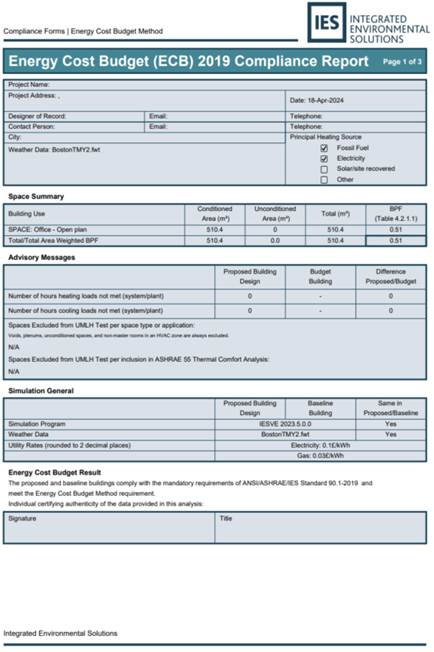
5. Automated Reports for ECB Compliance
The 90.1-2019 Navigator automatically produces reports for ECB Compliance, as per official ASHRAE templates.
6. Other notes for 90.1 2019 ECB:
The following should be noted for ECB 2019:
-
11.5.1 (3) - Space Use Classification:
-
-
New Exception: Where space types neither exist or are designated in design documents, use type shall be specified in accordance with Section 9.5.1 (Building Area Method)
-
-
-
New exceptions to be considered
-
-
-
For dwelling units, hotel/motel guest rooms, and other spaces in which lighting systems consist of plug-in light fixtures that are not shown or provided for on design documents, assume identical lighting power for the proposed design and baseline building design in the simulations
-
-
Where lighting neither exists nor is submitted with design documents, the lighting power in the budget building design shall be the same as in the proposed design
-
-
Note the updates for non-mandatory lighting controls i.e. lighting controls that are not required by Section 9.4.1
-
11.5.1 (7) – Thermal Blocks — HVAC Zones Designed
-
-
The space-use classification is the same throughout the thermal block, or all of the zones have peak internal loads that differ by less than 10 Btu/h·ft2 from the average.
-
All of the zones have schedules that differ by 40 or less equivalent full-load hours per week
-
11.5.1 (11) – Service Hot Water
-
-
Piping losses shall not be modeled
-
-
Service water-heating energy consumption shall be calculated explicitly based on the volume of service water heating required, the entering makeup water, and the leaving service water heating temperatures. Entering water temperatures shall be estimated based on the location. Leaving temperatures shall be based on the end-use requirements.
-
Service water loads and use shall be the same for both the proposed design and baseline building design and typical of the proposed building type.
-
Piping losses shall not be modeled