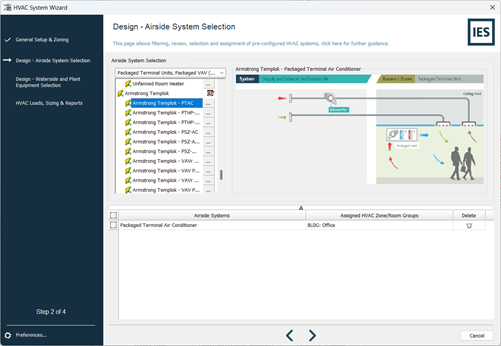
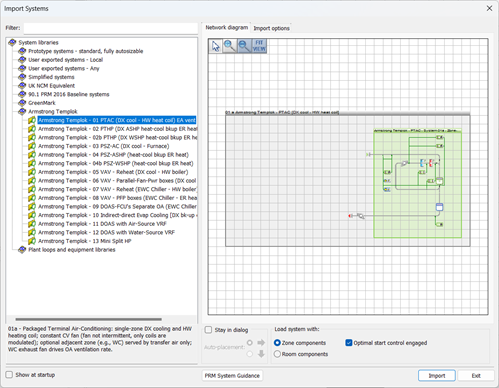
The IESVE comes pre-packaged with a set of Armstrong® HVAC systems covering all the standard system configurations in the VE. These systems are available in both ApacheHVAC and the HVAC design wizard.
Figure: Armstrong HVAC systems library
These systems have been specifically edited to work in collaboration with the Templok® PCM tile and have been configured with the following considerations:
Heating & cooling set point coordination
The Templok tile works best with a 3-stage heat/cool strategy i.e.
1. Heating
2. Templok passive
3. Cooling
It is worth considering widening the heating – cooling bandwidth and the night setback setpoints to give the PCM greater potential to work i.e. to go through its full cycle.
The following setpoints have been provided as default for the Armstrong systems. These can be adjusted as necessary for each individual project:
· Heating setpoint in each Armstrong system is set to 'Two Value'. The Main setpoint is 66 DegF (19 DegC) and the setback setpoint is 53 DegF (12 DegC)
· Cooling setpoint in each Armstrong system is set to 'Two Value'. The Main setpoint is 77 DegF (25 DegC) and the setback setpoint is 86 DegF (30 DegC)
Night purge ventilation
Mechanical night purge ventilation allows the Templok tile to discharge during unoccupied periods. This works particularly well in warmer and drier climates
[JC12] when the cool night time air can be used for discharge.
The control of the night purge is dependant on location and climate e.g. in warmer climates with a high day/night temperature swing it can be particularly effective, while in more heating dominated climates it may prove to be less effective and would require more time to work or to work at a greater capacity.
The effectiveness of night purge can also be impacted by the thermal mass of the building. It is also worth noting the cross over with setback temperatures and the control of the normal air conditioning strategy. Another reason to widen the setpoint bands so as to give the night purge the greatest opportunity to discharge the Templok tile but not sacrifice comfort conditions.
A typical night purge control strategy has been provided in the Armstrong systems:
· Night purge becomes active when:
o It is between 00:00 and 07:00 – 7 days a week (using a Templok modulating profile); and
o The outdoor temperature is between 50 DegF (10 DegC) and 64 DegF (18 DegC); and
o The outdoor relative humidity is less than 70%; and
o The indoor temp is greater than 55 DegF (13 DegC)
· The strategy provides 3 ach of outdoor air through the plenum and space via the HVAC system
To facilitate this for each Armstrong system:
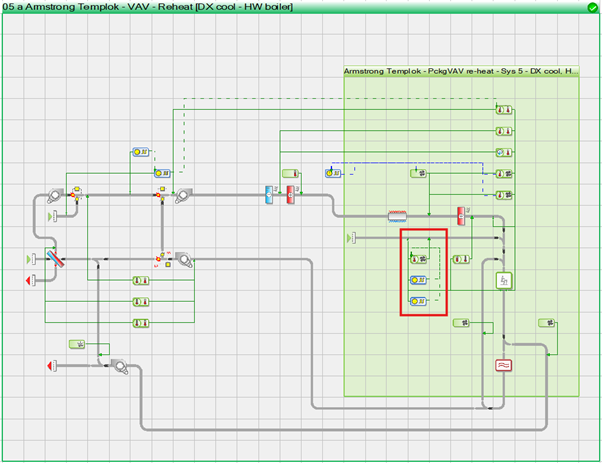
· An extra airflow controller has been added called 'Templok Night Purge - Outdoor Air Control'
· This is a time switch controller
· The controller variable is set to flow rate
· The max signal variation is set to constant with a value of 100 cfm (This will need to be changed by the user to be equivalent to 3 ach)
· The time switch profile is set to use the Templok modulating profile
Figure: Armstrong systems showing the night purge controllers
Summer / winter modes
Although Templok is chiefly beneficial in limiting temperatures and cooling loads in summer, it also has potential benefits during wintertime operation. This may occur due to excessive heat input from solar gains (exacerbated by low sun angles) combined with gains from lighting, equipment and occupants.
Under such conditions any latent heat stored in the PCM will be returned to the space as the PCM re-solidifies. As a result, unwanted heat gains which would otherwise have caused overheating or a demand for cooling is stored up and used later to hold the room temperature above the heating set point, thus delaying the time when heating might subsequently become necessary.
If the space heating set point is set correctly (as previously suggested 66 DegF (19 DegC)) the heat gain from the PCM should naturally benefit the space and hold off heating without further control adjustments (whether this is during or outside occupancy).
It is important to understand the role of the night purge strategy in heating dominated climates and the adjustments that need to be made in order for it to work to its highest potential, see Table 1.
Climate based adjustments:
While the typical strategy presented in the Armstrong systems are a good starting point, they will need to be adjusted based on the building location and climate and the following should be considered:
|
Climate Zone
|
Example Location
|
Adjustment
|
|
CZ 1A
|
Miami
|
The Miami climate is defined by warm to hot weather year-round, with distinct wet and dry seasons and with a small diurnal range (8-12 DegF). Humidity is high year-round, especially in the summer.
The hot humid days and warm humid nights means that a passive PCM reset is difficult and thus mechanical intervention is required. Using the typical night purge strategy in the AWI HVAC systems can help to achieve this but adjustments will need to be made to the cooling controls to provide mechanical cooling during the night purge. Dedicated mechanical discharge could also be considered.
Dedicated humidity control will be required (not included by default in the AWI HVAC systems)
The user should also consider raising the cooling setpoints to 76-78 DegF, but note the impact on occupant comfort, which can be assessed in the VE.
|
|
CZ 2B
|
Phoenix
|
Phoenix is one of the hottest major cities in the US, with extreme heat, very dry air and a long cooling season with very low humidity. During the shoulder seasons it tends to have a large diurnal range (~25-35DegF) while in the summer it tends to be tighter due to the heat island effect (~15-25DegF).
Thus, phoenix is a very promising climate for PCM and the HVAC night purge strategy presented in the typical AWI HVAC configuration should work well in this climate, taking advantage of the hot days and cooler nights. However due to the extreme daytime heat during the summer, some adjustments to volume flow and setpoint temperatures may be required to maximise the night vent strategy.
Also, supplementary mechanical discharge should be considered to address the extreme heat
|
|
CZ 3B
|
Los Angeles
|
The LA climate is defined by mild wet winters and hot dry summers, with a diurnal range of between 15-25 DegF depending on location, with a moderate swing experienced in the downtown central areas (summer daytime ~85DegF, night-time ~65DegF).
Thus, the HVAC night purge strategy presented in the typical AWI HVAC configuration should work well in this climate, taking advantage of the hot days and cooler nights.
As the summers are dry, it reduces the need for humidity control, thus simplifying integration.
Wider setpoints and occupancy-based controls should also be considered here (also included by default in the AWI HVAC systems
|
|
CZ 4A
|
New York
|
The NY climate is defined by cold damp winters and warm humid summers, with a diurnal range of between 10-20 DegF which is less pronounced than LA, due to higher humidity and heat island effects in the city (summer daytime ~85DegF, night-time ~70DegF).
Thus, for NY the typical strategy should be adjusted.
· Hot humid summers means the night-time PCM reset can be harder
· Cold winters means the focus shifts to heating
· Humidity control
The user should consider:
· Update the night purge strategy to provide more airflow (the default is 3ach), but only when conditions are ideal (cold nights)
· On hot humid nights, provide additional mechanical cooling by changing the main cooling control
· Add in humidity control
· Adjust setpoints (raise to 76-78 DegF)
· For shoulder seasons (heating) consider strategies that allow for heat storage in the PCM e.g. internal load distribution, direct solar radiation, warm air from HVAC return, etc
|
|
CZ 4B
|
Albuquerque
|
Here we have a climate with mild winters, hot summers, low humidity and high day-night swings (25-35DegF in shoulder and 20-25DegF in summer)
As Albuquerque’s climate is dry, predicable and with high diurnal swings it is very favourable for PCM use and the typical strategy presented in the AWI HVAC systems should work very well.
It should be noted that with winter conditions playing a larger role in this climate, heating based adjustments should also be made i.e. consider internal loads distribution
|
|
CZ 5A
|
Chicago
|
Chicago has four distinct seasons, with cold winters and warm to hot summers where humidity can be high. During the summer the diurnal swing can be 15-20DegF.
Thus, for Chicago the typical strategy should be adjusted.
· Hot humid summers means the night-time PCM reset can be harder
· Cold winters means the focus shifts to heating
· Humidity control
The user should consider:
· Update the night purge strategy to provide more airflow (the default is 3ach), but only when conditions are ideal (cold nights)
· On hot humid nights, provide additional mechanical cooling by changing the main cooling control
· Add in humidity control
· Adjust setpoints (raise to 76-78 DegF)
· For shoulder seasons (heating) consider strategies that allow for heat storage in the PCM e.g. internal load distribution, direct solar radiation, warm air from HVAC return, etc
|
Table 1: Suggested climate adjustments to the HVAC strategy