Example Modulating Profiles
The following are some useful formulae for modulating profiles.
ta>24 1 when ta is greater than 24, and 0 otherwise
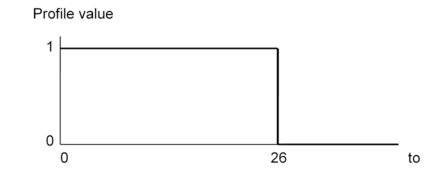
to<26 1 when to is less than 26, and 0 otherwise
ta>20 & ta<24 1 when ta lies between 20 and 24, and 0 otherwise
ta>to 1 when ta is greater than to, and 0 otherwise
ta>=21 & to>=12 1 when ta is greater than or equal to 21 and to is greater than or equal to 12, and 0 otherwise
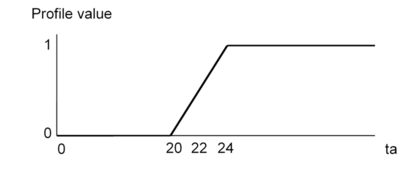
gt(ta,22,4) 0 when ta<20 and 1 when ta>24, with a linear ramp in between (a proportional band of width 4K between 20 and 24)
ramp(ta,20,0,24,1) an alternative to the above formula
gt(ta,to,4) rises smoothly from 0 to 1 as ta increases through to, the transition occurring over a band of 4 degrees
lt(to,18,2) & lt(to,ta,4) 1 when to<18 and to<ta, and 0 otherwise, with bands of width 2 and 4, respectively.
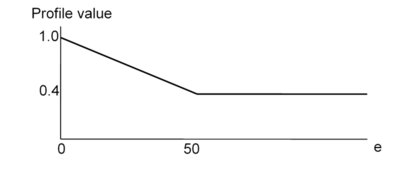
ramp(e1,0,1,500,.4) a formula suitable for applying as a dimming profile controlling lighting gain as a function of available daylight. It modulates the lighting gain as a function of the illuminance on the working plane, e1. The value of the profile falls from 1 at zero illuminance to 0.4 at illuminance 500 lux, thereafter remaining constant at this value. The value 0.4 (which you should set as appropriate) represents the fraction of the room’s lighting gain which is not subject to daylight control. The illuminance e1 must be computed using the link to Radiance.
Example Absolute Profiles
The following are some useful formulae for absolute profiles.
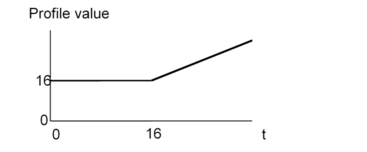
if(to<16,16,to) 16 when outside air temperature (to) is less than 16 and to when to is greater than 16 (a supply condition for mechanical ventilation when heating, but not cooling, is available)
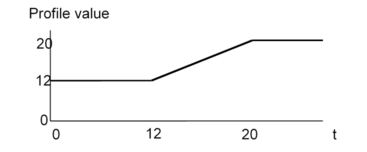
ramp(to,12,12,20,20) emulates a supply condition for mechanical ventilation when the outside air is heated to 12 and cooled to 20.
if(to<12,12,if(to<20,to,20)) an alternative to the above formula
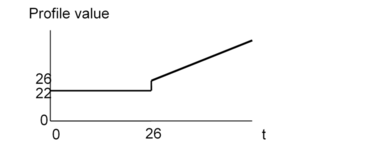
if(to<26,22,to+4) 22 when to is less than 26 and to+4 when to is greater than 26 (an adaptive room set-point)
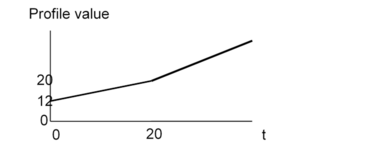
if(to<20,to+.6*(20-to),to) emulates a mechanical supply condition where heat recovery is applied to an outside air supply. The return air is assumed to be at 20°C and the effectiveness of the heat recovery device is 60%.