What is Armstrong Ultima Templok®?
Templok ceilings are acoustical ceiling tiles manufactured by Armstrong World Industries, enhanced with an integrated layer of phase change material (PCM). This PCM acts as concentrated thermal mass, absorbing and releasing heat as it transitions between liquid and solid phases inside the tile. The PCM is engineered to change phase near room temperature, increasing the thermal inertia of the zone in a comfortable range by storing and releasing latent heat as temperatures around the material fluctuate. Templok ceilings passively moderate the indoor temperature, reducing HVAC system loads and enhancing occupant comfort.

The PCM layer is bonded to the top surface of each Templok ceiling tile, preserving the visual and acoustical properties of the ceiling. Templok ceilings are offered as upgraded versions of popular ceiling tiles, such as Ultima. Templok tiles (e.g., Ultima Templok) are installed exclusively in full grid openings, typically covering approximately 50-70% of the acoustical ceiling area. Standard matching acoustical tiles (e.g., Ultima) are installed in areas where tile cutting is required around ceiling fixtures and perimeters.
|
|
|
|
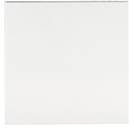
Figure: Downward facing (left) and upward facing (right) sides of an Ultima Templok ceiling tile. The tile is 24x24-inches with four 9x9-inch sections of enclosed PCM on the upper side.
|
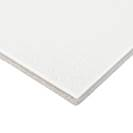
Figure: Closeup of corner of downward facing (left) and upward facing (right) portions of an Ultima Templok ceiling tile.
|
How Do Templok Ceilings Work?
Templok ceilings manage thermal loads passively in response to changes in indoor temperatures, typically melting during the day and re-freezing overnight. The thermal energy stored and released with Templok can offset both heating and cooling loads.
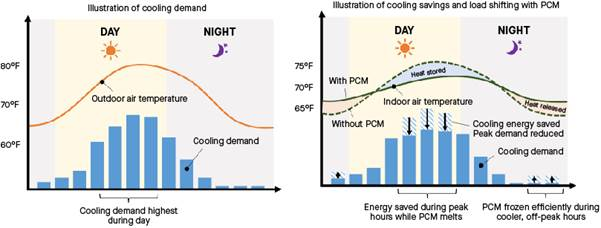
On cooling days, the PCM absorbs heat as temperatures rise, reducing the cooling system load. During cooler nighttime periods, the PCM refreezes, recharging for the next day. Templok can be implemented as a passive measure in zones that experience natural diurnal temperature swings, shifting cooling loads away from peak periods and reducing overall cooling energy usage. Performance can be further improved through strategies such as nighttime ventilation, which efficiently refreezes the PCM during cooler early-morning hours.
Figure: Illustration of typical cooling savings mechanism
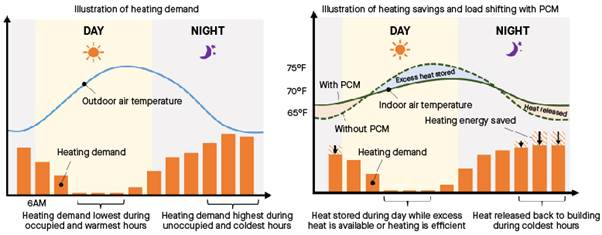
On heating days and in shoulder seasons, the PCM captures excess heat developed in the building during the day and releases it overnight, reducing the need for morning heating. The PCM can also reduce intraday heating and cooling demand by passively maintaining room temperature closer to setpoint through cooler mornings and warmer evenings.
Figure: Illustration of typical heating savings mechanism
Within IESVE, Templok is modeled as a surface tile, enabling simulation of its thermal interactions in its built environment and assessment of its impact on building energy performance.