For buildings other than schools it is likely CIBSE TM52:2013, ISO 7730: 2005 or ASHRAE 55: 2013 will be utilised to assess comfort performance.
For schools in the UK & Eire BB101:2018 is the definitive guidance on performance. The performance standards in BB101:2018 require:
· Thermal comfort performance checks:
For buildings operating in a free running mode adaptive comfort is specified using CIBSE TM 52 (BB101:2018 7.6). This involves three criteria, taken together, to be used to assess the risk of overheating of the building in the UK, using the geographically closest CIBSE Design Summer Year (DSY1 2020 50th percentile) weather file. A room or building that fails any two of the three criteria is classed as overheating:
· Criteria 1- Hours of Exceedance: During the occupied hours of the non-heating season (1st May to 30th September), the predicted operative temperature should not exceed the maximum adaptive temperature by 1°K or more, for less than 40 hours;
· Criteria 2- Daily Weighted Exceedance: For the severity of overheating, which can be as important as its frequency, the weighted exceedance of the temperature rise and its duration should be less than or equal to 6 during any occupied day of the non-heating season;
· Criteria 3- Upper Limit Temperature: The absolute maximum daily operative temperature for a room, beyond which the level of overheating is unacceptable, should not be greater than or equal to 4°K, than the maximum adaptive temperature (Top – Tmax), at any time.
For buildings operating in a mechanically cooled mode PMV is specified as CIBSE Guide A (BB101:2018 3). This references ISO 7730 and PMV thresholds of:
· Category I (A) +0.2 (<6% PPD).
· Category II (B)+0.5 (<10% PPD) (Normal).
· Category III (C) +0.7 (<15% PPD).
· Air quality performance checks:
With regards to internal air quality, BB101:2018 (2.4) criteria specifies that for natural ventilation or hybrid systems operating in natural mode:
· In all teaching and learning spaces when measured at seated head height, during the continuous period between the start and finish of teaching on any day, the average CO2 concentration of carbon dioxide should not exceed 1500 parts per million (ppm).
· The maximum CO2 concentration should not exceed 2000 parts per million (ppm) for more than 20 minutes each day.
· The system should be designed to achieve a CO2 level for the majority of the time of less than: 1200 ppm for a new building (800 ppm above the outside CO2 level, taken as 400ppm) and 1750ppm for a refurbished building (1350ppm above outside CO2 level).
For systems operating in mechanical ventilation or hybrid mechanical mode, BB101:2018 (2.4) criteria specifies that:
· In all teaching and learning spaces when measured at seated head height, during the continuous period between the start and finish of teaching on any day, the average CO2 concentration of carbon dioxide should not exceed 1000 ppm;
· The maximum CO2 concentration should not exceed 1500 parts per million (ppm) for more than 20 minutes each day.
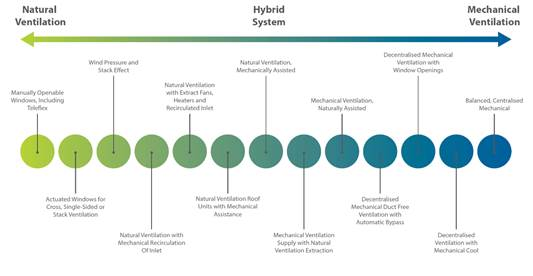
BB101:2018 1.2.3 and figure 1-2 describe system types and operating modes.
Fig 1: BB101:2018 figure 1-2
The VE provides tools for assessing performance requirements for all these standards via the VistaPro Comfort Analysis tool. Both natural and mechanical modes are assessable.