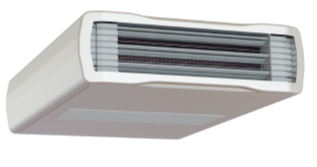
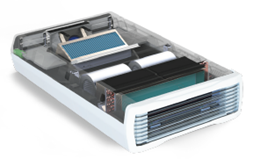
Monodraught Hybrid Ventilation (HVR) APX system with heat recovery and room heating
The next generation of HVR Zero, APX, represents a significant step forward in low energy hybrid ventilation technology. Ensuring excellent air quality is more crucial than ever due to its profound impacts on public health, environmental sustainability, social equity, and economic well-being. The system now incorporates an array of additional monitoring tools to enhance Indoor Air Quality (IAQ). These upgraded sensors monitor internal temperature, humidity, VOC, pollution levels, air flow rates, and CO2 concentration.
A key feature of the new system is the Passivhaus level of airtightness. The system has been designed to exceed the requirements in the latest CIBSE TM23 guidance which requires ventilation systems to be closed but not sealed during the air testing of buildings, and every system is supplied with an airtightness test certificate.
The system has improved heat recovery and an enhanced two-pipe coil. Specifically designed for compatibility with renewable heating and cooling solutions such as air source or ground source heat pumps. The APX can future proof buildings with the standard provision for cooling.
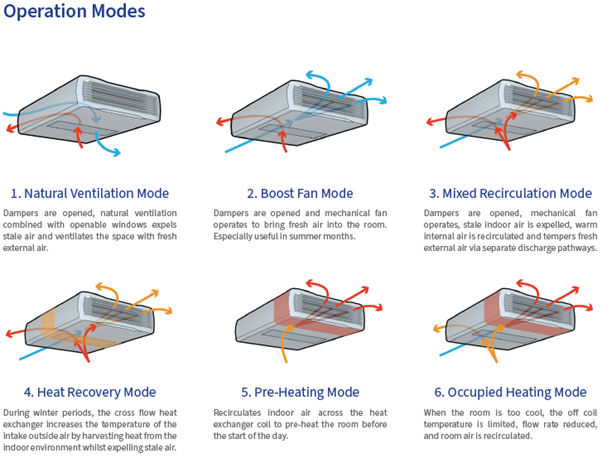
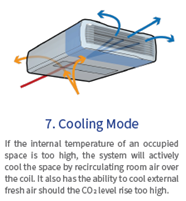
The system comprises of an intelligent and fully automatic control system coupled with a low energy ventilation system which switches between operational modes dependent on season, external/internal temperature conditions and indoor air quality (IAQ). At all times the system will utilise natural ventilation as its primary mode, then as the internal room temperatures or CO2 concentration increases, the low energy internal fan will operate to provide fan assisted natural ventilation at variable speeds dependent on the internal room conditions. System automatically provides secure night time cooling through natural ventilation opening or fan assisted if required. Winter ventilation automatically modulates dampers to mix re-circulated air with external air to ensure optimum ventilation temperatures.
Monodraught HVR APX System
Further details on the units, control strategies and technical data is provided in this user guide (see HVR Background and Appendix B: HVR Technical Data). For the latest details on the HVR product line or to discuss potential suitability for your project, please visit: