Comfort analysis (design)
Depending on building type users are likely to be using TM52 or BB101 standards to assess comfort.
CIBSE TM 52 & BB101 utilise operative temperature for free-running buildings and PMV for mechanically cooled buildings. However, it is important to note that operative temperature does not fully allow for the effect of air speed on occupant comfort (see TM 52 box 1 and CIBSE Guide A).
As the Passivent Roof Terminals product are designed to provide direct airflow on occupants during the appropriate mode assessing the comfort benefit for design purposes (rather than compliance) might benefit from being carried out using the PMV method in all modes.
In VistaPro select the rooms to be included in the comfort analysis. Selecting now will include rooms.
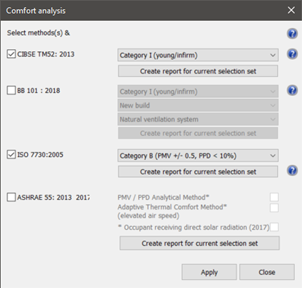
In the VistaPro > Comfort analysis dialog users can select the check box for ISO 7730: 2005.
Fig 17: Vistapro – comfort analysis dialog (ISO 7730)
Select a category suitable for the project, nominally Category B. Vistapro will then post process additional room variables and these will be shown in the VistaPro > variables picker with the following prefixes:
1. PMV (ISO 7730 …
2. PPD (ISO 7730 …
A number of these variables are provided for different air speed settings so that the benefit of the Passivent Roof Terminals® unit can be assessed and compared. Variables prefixed ISO 7730 nom & elev air speed … apply the elevated air speed per time-step when the PMV calculated at the nominal air speed exceeds the selected category upper limit (for category B this is PMV +0.5) thus reflecting the function of the Passivent Roof Terminals® unit.
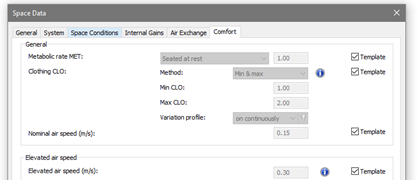
Clothing also affects comfort; this is set for each room by template or on space data:
Fig 18: Space data comfort tab
As comfort is post-processed these inputs can be changed post-simulation. CLO value can be fixed, set by profile or set to a min or max value per time-step to give a best result (See VE help); these options provide a means to mimic occupant behaviour. Sensible default values are applied when Passivent Roof Terminals is assigned or re-assigned to a space.
On this dialog you can also adjust the nominal and elevated air speed values for this assessment.
Typically, one might compare PMV (ISO 7730 nominal air speed) with say PMV (ISO 7730 nom & elev air speed cat B) to assess the benefit of the Passivent Roof Terminals summer operation for design purposes.
The Create report … option on the dialog will generate a report.