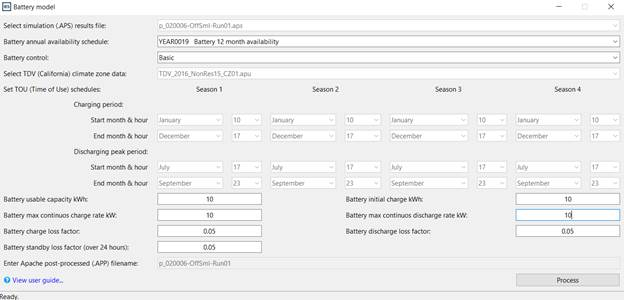
Battery storage is now part of the proposed model and acts upon the proposed results that have been created previously. This action displays ‘Battery Storage’ dialog which allows the user to edit battery storage properties and perform a post process analysis on a set of Apache simulation results.
Battery Storage Model
There are three control options available for Title 24 simple batteries:
Basic
Battery charges whenever there is excess PV. Battery discharges to meet house load when PV does not cover it. Battery only meets house loads and does not put power into grid (but PV can directly export).
Time of Use / Time of Use Stand-alone Battery
Battery charges whenever there is excess PV. During peak summer months (July - September) start discharging at the beginning of the peak period (that varies with climate zone) at maximum rate until fully discharged. Other months run with basic control. Battery will put power into grid after meeting house load if discharge rate allows it. Default operation mode allows charging from an on-site PV system or from the utility grid if a stand-alone battery storage system is used.
Advanced DR Control.
During peak summer months control knows that it is going to be a peak day and what the peak hours will be. On a peak day, use all PV to charge the battery until it is full. Discharge at maximum rate during highest TDV hours. Otherwise run with basic control. Battery will put power into grid after meeting house load if discharge rate allows it. Programmed as Basic Control or TOU control. Upon receipt of DR signal, the battery can change the charge/discharge periods to coincide with highest value critical peak hours.
Note: Batteries are also added to the standard model based on the requirements of the standard. This is handled automatically by the software