3.4.5 Step 5. Create HVAC and DHW Systems
It is recommended that HVAC and DHW systems characteristics for VE Compliance analysis are specified within the framework of Apache Systems. Apache Systems provide a robust and uncomplicated system model that has been harmonised with that provided in iSBEM with the aim of providing a point of reference and common ground between these alternative compliance methods.
Systems are one of the aspects of building design where substantial carbon emissions improvements can be introduced. The system data is therefore under your control, and it is shared between the real building (as displayed in the Apache module) and the actual building (as displayed in VE Compliance).
The Apache System dialogs as they appear for simulation-based ratings methods are described in detail in the VE Compliance user guide. The following is a summary.
The Apache System HVAC model has three key parameters, which can be defined in summary as follows:
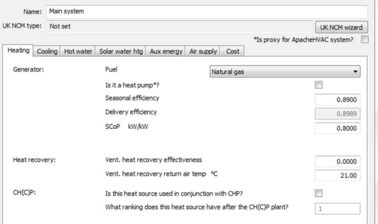
SCoP – the efficiency of the heating system
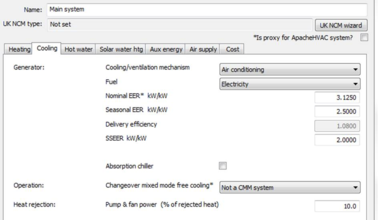
SSEER – the efficiency of the cooling system (if present)
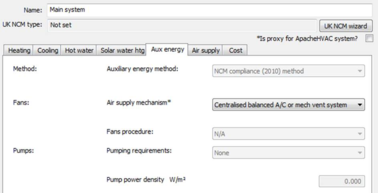
Auxiliary Energy Value – energy required for fans, pumps and controls
These are the most important parameters featuring in the calculation of the energy consumed by the space heating and cooling systems. Taken together with the fuels specified for heating and cooling, they encapsulate most of the important data about system performance in relation to carbon emissions.
On the Apache System dialog there are other parameters that are linked with the heating and cooling system efficiencies and do not represent independently editable settings. For example, the heating system’s Generator seasonal efficiency and Heating delivery efficiency are linked to the SCoP by the relation
SCoP = (Generator seasonal efficiency) × (Heating delivery efficiency)
so that in terms of carbon emissions they can be viewed as secondary to the SCoP.
On the cooling side an analogous relationship exists between SSEER and the following parameters:
EER – the cooling system generator energy efficiency ratio or COP
CDE – the cooling delivery efficiency, and
HRP – the heat rejection pump and fan power fraction
namely
SSEER = EER * CDE / (1 + (EER + 1)*HRP)
In terms of carbon emissions EER, CDE and HRP can thus be viewed as secondary to the SSEER.
These ‘secondary’ parameters are important for certain design tasks in the Apache module – for example the calculation of boiler and chiller loads. But for VE Compliance, SCoP and SSEER are the key efficiency measures.
Auxiliary energy value is a concept that has been developed in connection with the NCM methodology. This parameter indicates the power consumption of fans, pumps and controls associated with the space heating and cooling systems. It is expressed in terms of Watts per square metre of floor area served, and is incurred when the heating, cooling or ventilation systems are running.
Auxiliary energy values are derived by the UK NCM System Data Wizard in line with guidance in the NCM Modelling Guides for Scotland Section 6 (2022).
The UK NCM System Data Wizard has been developed as a replica of the analogous facility in iSBEM. Its purpose is to guide you through the process of describing the system properties and to generate values for the three key parameters.
In addition to the key parameters mentioned so far, there are other system parameters of importance such as heating and cooling system fuels, ventilation heat recovery effectiveness. These are also generated automatically from data entered in the wizard.
Other data entered via the wizard, such as metering provision, also affects system performance without being reflected in parameters appearing on the main Apache System dialog. More information on using the wizard is provided in the VE Compliance User Guide.
Nomenclature for heating, cooling efficiencies has recently been introduced that aligns VE Compliance with the NCM.
SCoP and SEER values for commonly available plant can be found from Manufacturer’s data.
The Apache System approach to DHW systems is slightly different from that adopted in iSBEM, but allows essentially the same flexibility. By default DHW is assumed to be the supplied by the same Apache System as the space heating system. If the building has a separate DHW system this can be created as an Apache System and connected to the rooms it supplies by means of the DHW System selector on the Room Data System tab. The efficiency of the DHW system must be expressed in terms of a generator (eg boiler) efficiency and a DHW delivery efficiency, the overall efficiency of the system being the product of these two efficiencies.
The DHW system wizard enables the definition of the delivery efficiency, storage and the secondary circulation efficiencies and pumping power. The DHW heating demand can be derived from a solar water heating system. This system will use solar power, when available, to pre-heat the water for the DHW system. A storage system can be defined for the solar water heating system.
The assignment of HVAC and DHW systems to rooms is described below.