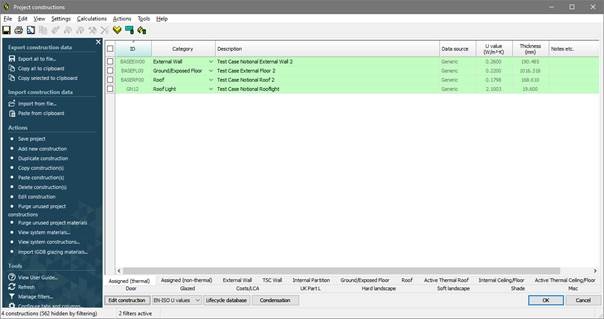
Constructions for building elements such as walls, roofs and glazing are created in the Constructions Database (CDB) utility accessible via Apache View or VE Compliance. They should satisfy the U value requirements. The construction definition should include allowance for non-repeating thermal bridging, using an area-based thermal bridging coefficient. Constructions may be assigned to building elements in either Apache View or VE Compliance.
Note that VE-SBEM assumes the ground floor U values entered in CDB have already been corrected in accordance with EN ISO 13370. This also means the floor area/perimeter method of calculating the ground floor should not be used, because it does not incorporate this correction. (This is different from iSBEM, which does allow uncorrected U values, with SBEM applying the correction internally).
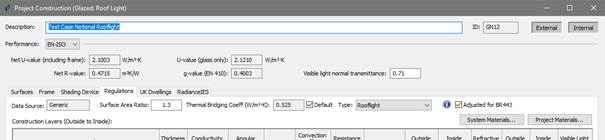
Note that for VE type roof-lights the CDB interface provides an option Adjusted for BR443. This is only relevant to VE-SBEM.
It has the following impact:
· For sub-type roof-lights:
Checked: SBEM is informed the U value has been corrected to the horizontal; and SBEM makes no adjustments. The SBEM BRUKL shows this U-value.
Unchecked: SBEM is informed the U value has NOT been corrected and SBEM makes adjustments from the vertical (if horiz +0.3, if pitched +0.2). The SBEM BRUKL shows this adjusted U-value.
· For sub-type roof-windows:
SBEM assumes the U-value is always in the vertical and SBEM makes no adjustments for sloping or horizontal roof-windows. The SBEM BRUKL shows this U-value.S
Roof-light & roof-window product data may be provided in the vertical plane so the user should make suitable adjustments manually; BE443 gives guidance, however the NCM guidance (+0.3/+0.2) is recommended for consistency with SBEM & BRUKL.
Part L (2021) requires certain attributes to be entered for constructions in addition to the data required for other thermal calculations. The additional attributes (broken down by construction category) are:
The contents of 2.4.3 Step 3. Create and assign constructions