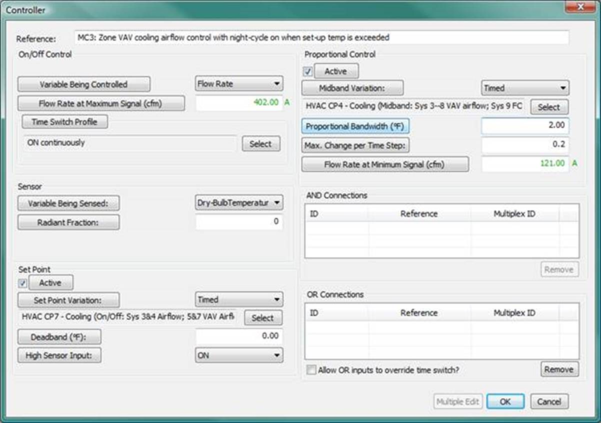
3.1.1 Reducing control bandwidths for tighter control or to avoid overlapping control bands
To reduce the control bandwidths, simply modify the values for Proportional Bandwidth. As with any controller parameter within the zone-level multiplex region of the system, this can be executed as a global edit, a local edit, or via tabular edit by clicking the parameter label when in global edit mode.
o Reducing the cooling airflow control band from the default 2°F to 1°F without adjusting the midband profile would allow the heating and cooling setpoints to be moved 0.5°F closer without overlap (i.e., to a minimum separation of 3.5°F
o If the same change from the default 2°F to just 1°F was made in the zone re-heat coil controller, this will shave another 0.5°F from the required separation, allowing the setpoints to be just 3.0°F apart without overlap.
o The reduced minimum required separation of setpoints noted in the examples above assumes that it is acceptable to have no actual deadband at all. This will tend to lead to control instability, particularly if using relatively large simulation time steps, and potentially forcing simulation with very small time steps (1 or 2 minutes) to avoid modeling excessive energy consumption as a result of unstable zone temperatures and the absence of an actual deadband.
o While it will not change the required separation of setpoints, similarly reducing the bandwidths for Cooling SAT reset and Heating airflow controls will reduce the overall throttling range, and thus apply the full potential of system heating and cooling over a narrower range of zone temperatures. Again, there is some risk of added instability, but not nearly so much or with such energy-intensive implications as eliminating the deadband between heating and cooling controls.